Home/Territory Hub/FRAÎCHEUR
Territory Hub · FRAÎCHEUR

Prioritize urban cooling.

FRAÎCHEUR helps public teams decide where the city should be cooled first — and where intervention levers are already visible.

Heatwaves force cities to choose between trees, shade, permeable surfaces, water points and cool places. FRAÎCHEUR ranks 200 m grid cells by the need for action, while keeping the question of mobilizable levers separate.

Lyon demonstratorv2.0
16,474
grid cells analyzed
200 m grid, Lyon metropolitan area.
1,579
P1 cells
Very high relative priority.
88
urban areas
Cerema LCZ coverage, transferable method.
Decision support for teams

A tool to bring planning, climate adaptation, health and public works around the same table.

FRAÎCHEUR is not just a map. Its value lies in the discussion it makes possible: compare overheated sectors, identify sensitive populations, locate cool resources and prepare defensible interventions.

The map supports arbitration; it does not replace it.

Territorial team reviewing an urban heat map and cooling scenarios
Collective review of an urban heat map, with cooling corridors, planting and shading scenarios.
FRAÎCHEUR in action

A fine-grained view of where heat, vulnerability and limited access to cool resources accumulate.

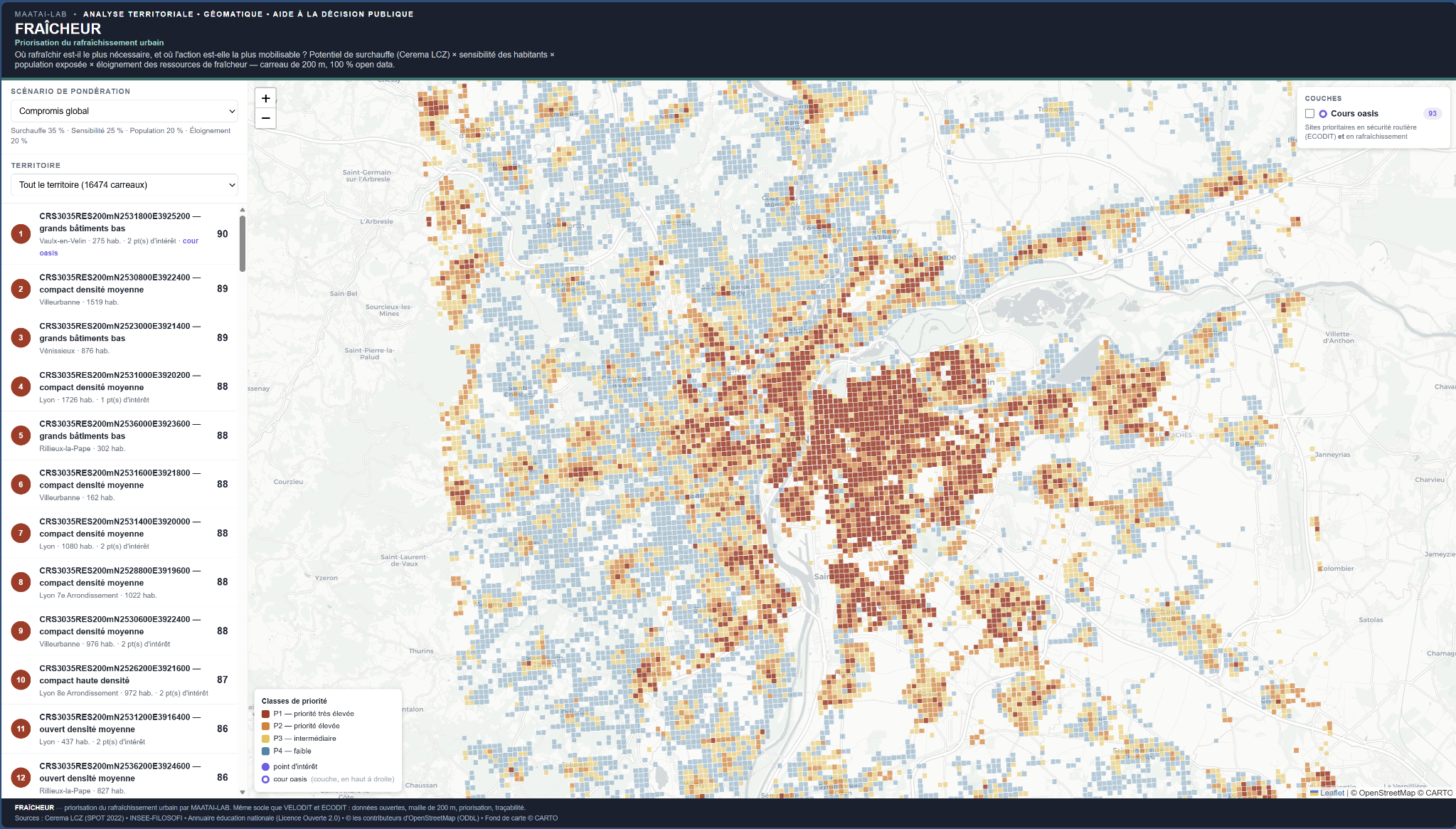
The interface shows priority grid cells, territory filters, P1 to P4 classes and the cross-layer with ECODIT, including schoolyards that deliver a double benefit.
FRAÎCHEUR · OverviewOpen full size ↗
FRAÎCHEUR interface showing urban cooling priority grid cells across the Lyon metropolitan area
Urban cooling prioritizationA complete map to rank sectors, filter territory and explain priorities.
Urban cooling
PrioritizeRank grid cells by need for action without claiming to measure absolute temperature.
SeparateKeep priority and apparent intervention potential separate to avoid easy-but-less-necessary choices.
ExplainConnect every rank to sources, score dimensions and sensitive places present in the cell.
Method

Four priority dimensions and a separate intervention axis.

The priority score answers: where is cooling most needed? Apparent intervention potential answers another question: where do levers already seem identifiable?

01

Overheating potential

Morphological reading from Local Climate Zones: compact, mineral, vegetated or water-related urban fabrics.

02

Resident sensitivity

Older people, young children and poverty: populations more vulnerable to extreme heat.

03

Exposed population

Number of residents concerned, increased when schools, care homes or childcare facilities are present.

04

Access to cool resources

Distance to parks, woods, water, fountains and vegetated areas, with caution on real pedestrian access.

Local view

Filter by district, then open the grid-cell file.

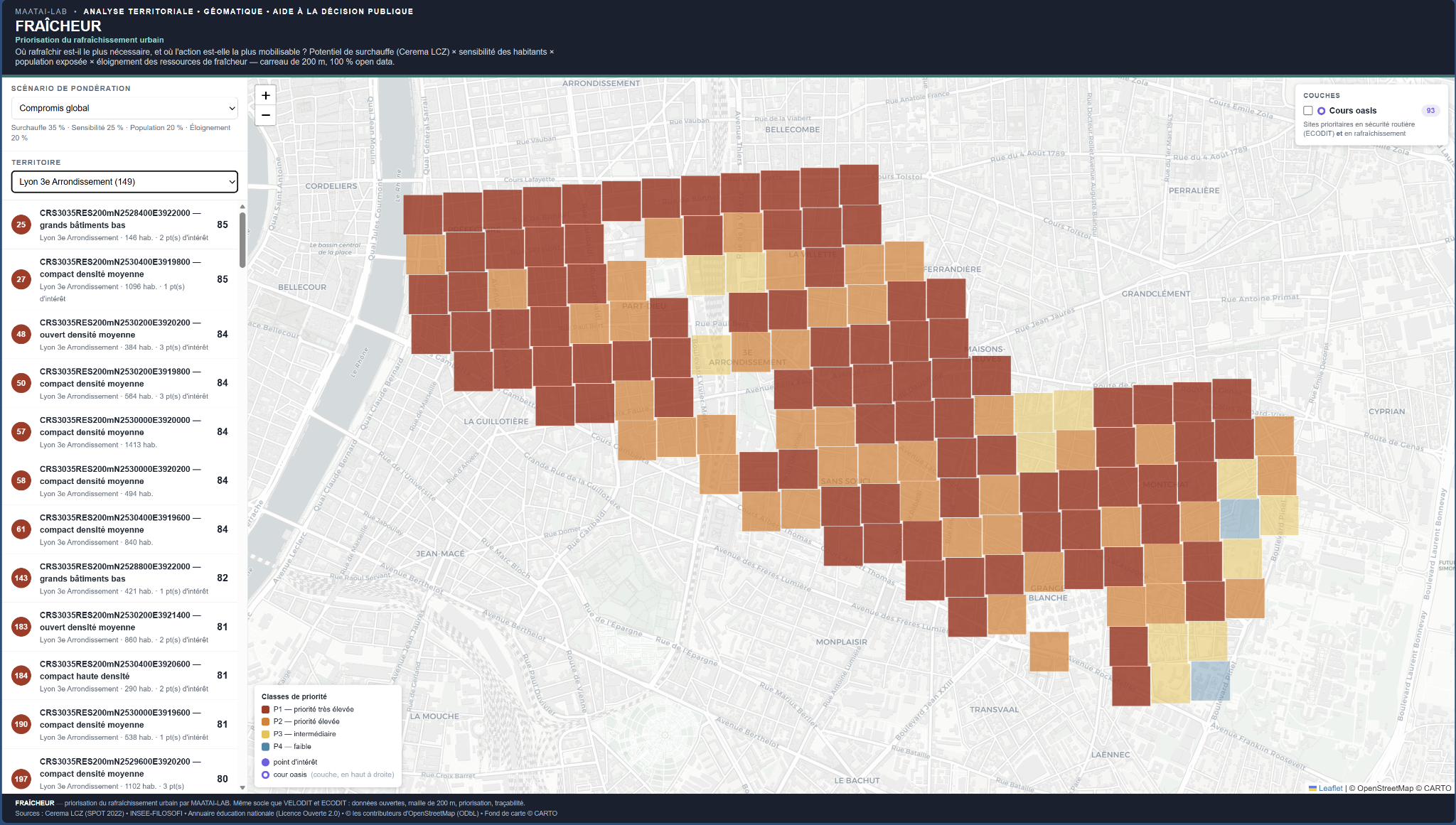
FRAÎCHEUR moves from a metropolitan view to a district-level reading, then to a detailed file explaining the score, priority dimensions, points of interest and intervention hypotheses.
FRAÎCHEUR · District viewOpen full size ↗
FRAÎCHEUR interface filtered on one district with priority grid cells and sector list
Street-level contrastsThe district view reveals priority sectors at an operational scale.
Local reading
Deliverable

A programming matrix, embodied by actual places.

Crossing priority and intervention potential produces four action families. Schoolyards that also emerge through ECODIT become especially clear priorities.

3,797Mobilizable priority interventionsHigh need and visible levers: the short-term base.
321Sectors requiring specific solutionsHigh need but heavier constraints: not to be abandoned.
5,276Complementary opportunitiesLevers present, lower need: to capture along projects.
7,080Limited priorityRelatively favorable situation to monitor.
ECODIT × FRAÎCHEUR bridge

Oasis schoolyards where one intervention serves two goals.

The bridge with ECODIT highlights schools that are priority sites for both road-safety surroundings and cooling. These sites make programming easier to explain: protect children from heat while improving their everyday environment.

The territory one-pager presents VELODIT, ECODIT and FRAÎCHEUR together.
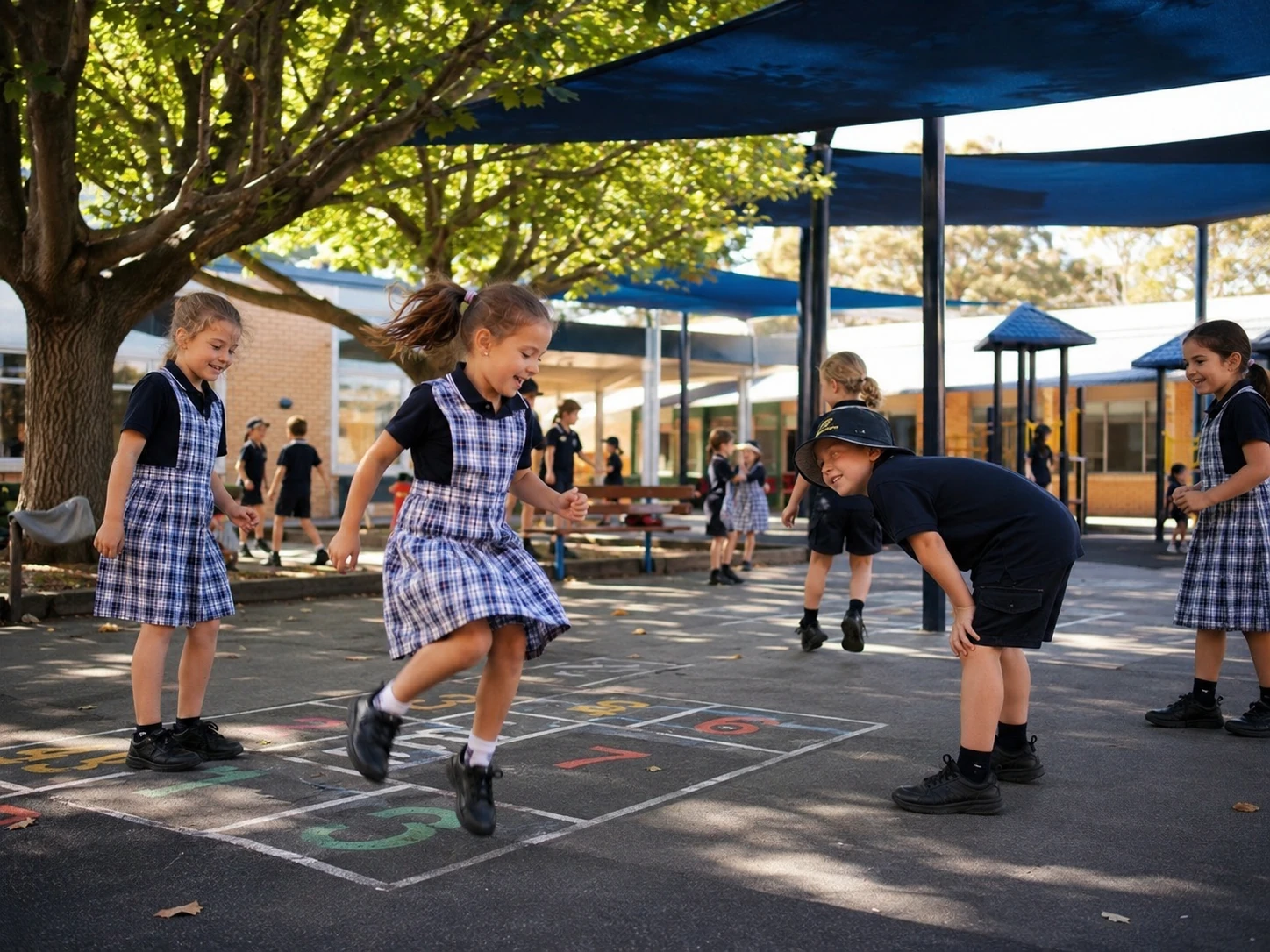
Children playing in a schoolyard shaded by trees and shade sails
A shaded schoolyard illustrates the double benefit: safer surroundings and better thermal comfort for children.

Test FRAÎCHEUR on your territory.

A pilot can produce a ranked list of inhabited grid cells, an interactive map, priority-sector files and a review workshop with your teams.

Discuss a pilot →